September 7, 2026
A room, not a stage
Group chats arrive in the Folk tab as groves — rooms whose faces are built from the people in them, planted in two steps, and drawn into the constellation without ever reading as a person.
The Folk tab has always measured one thing: closeness between two people. A ladder for the list-minded, a constellation for everyone else. But group conversations existed under it the whole time — every group chat is a personal forest server-side, and there was simply no surface that showed them. Today they get one, and a name: groves.
A face built from people
The first question wasn’t where groves live — it was what one looks like. A group needs a mark, and the easy answer is an uploaded icon and a naming committee. We explored five constructions instead, every one composed from the members’ existing avatars.
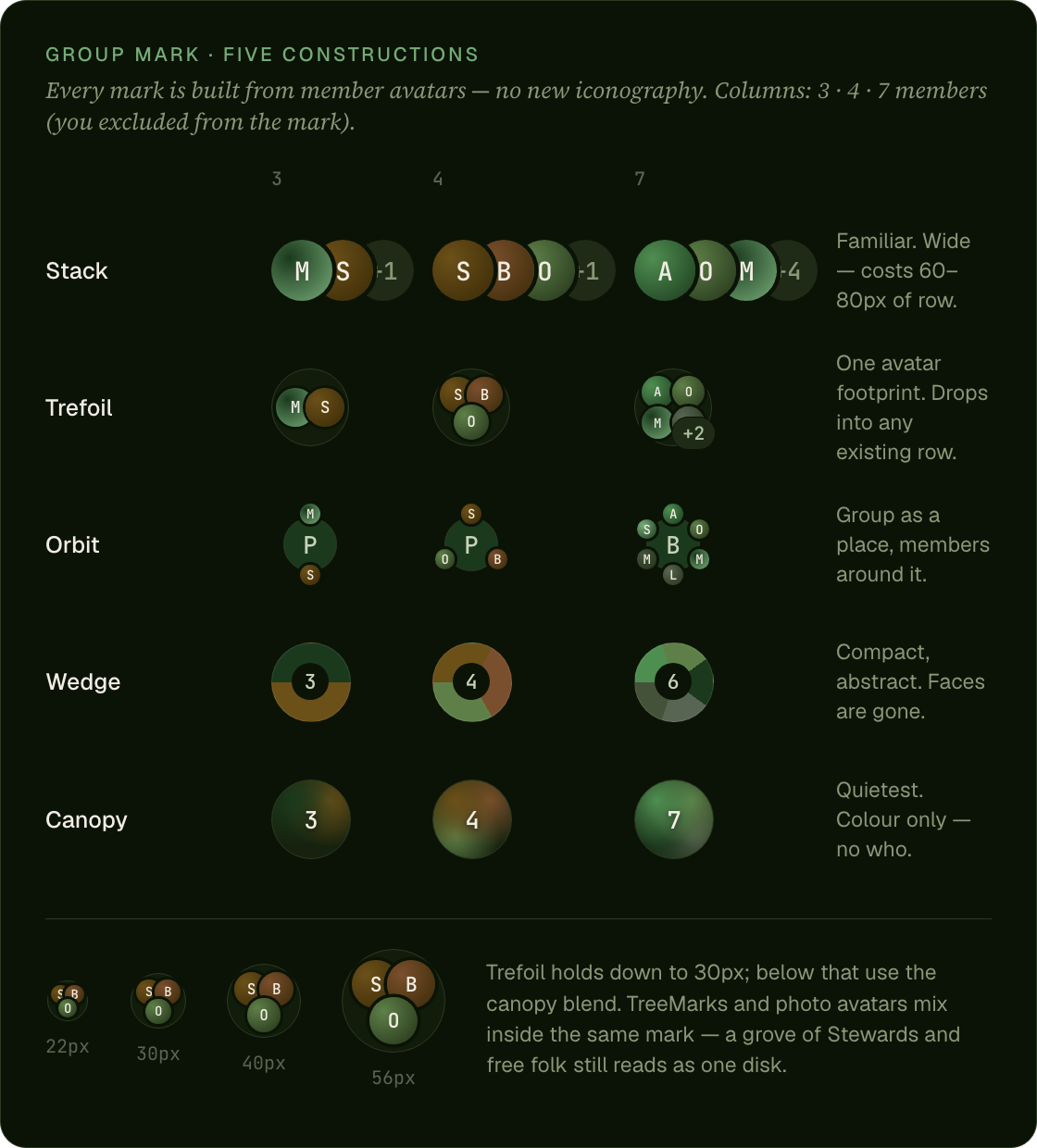
The trefoil won for a structural reason: it occupies exactly one avatar footprint, so a grove drops into any row a person could occupy, with zero new layout. The orbit — members circling a centre initial — earns its space only on the grove’s own card, where the group-as-place reading helps. The stack was too wide, the wedge lost the faces, the canopy said nothing about who. And the deeper decision hiding in all five: a grove has no avatar of its own. Its face is a by-product of who’s in it.
The third position on the dial
Groves get their own view, between the ladder and the rings. The order is deliberate — groves sit next to the list they grew out of, and the constellation stays the far end of the dial, the view you go to on purpose.
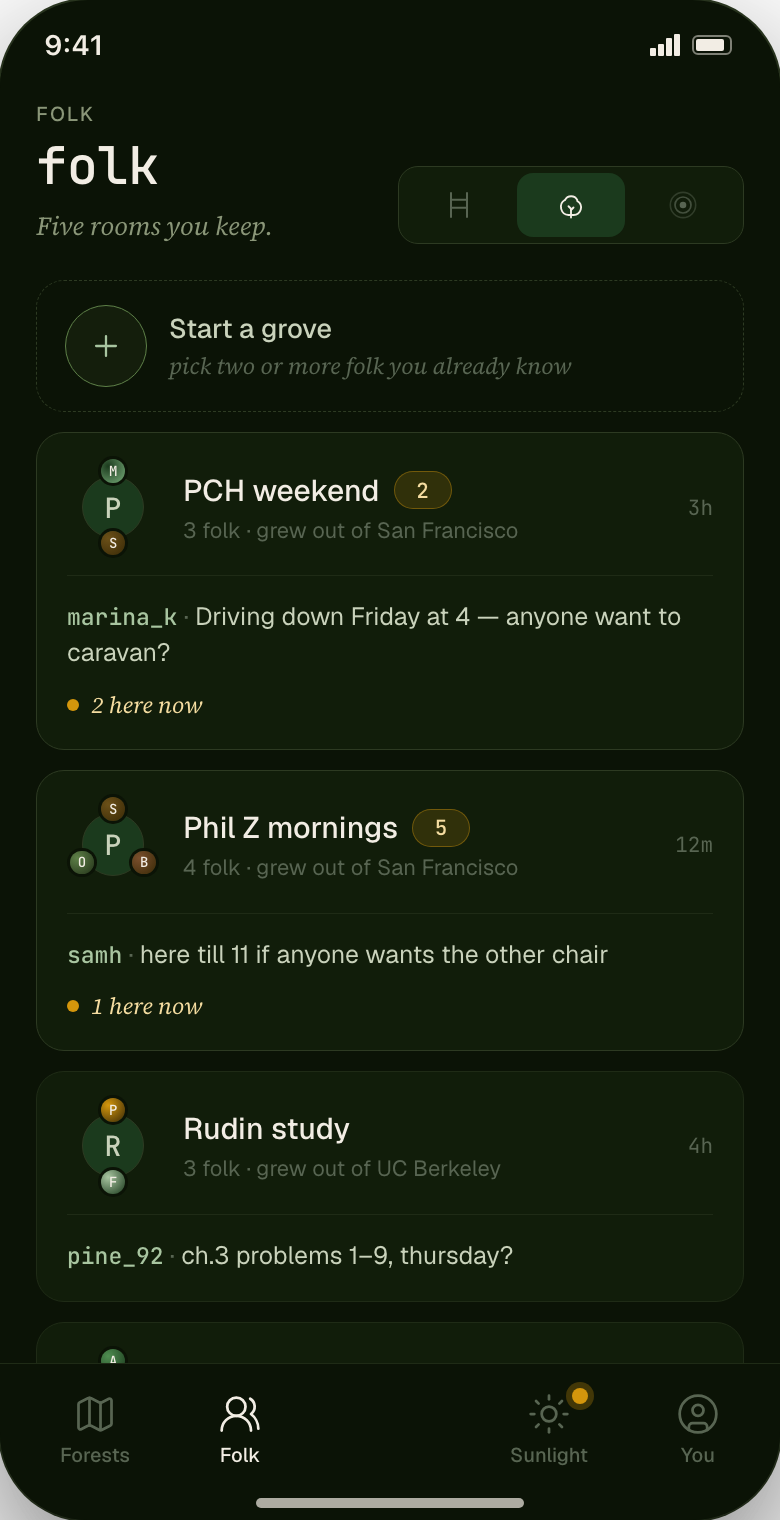
Each card carries the room’s name, its count, and — only when it’s true — provenance: grew out of San Francisco. A grove made from the Folk tab has no forest behind it, and the line simply doesn’t render. Nothing fuzzy, nothing guessed.
Look closely at the board above and you’ll see two things the shipped app doesn’t have. The 2 here now presence line went because there is no presence substrate underneath it, and inventing one for a card line is the tail wagging the dog. The amber unread pill went for a harder reason: the number the server could produce was never true. The reading state it depended on was recorded nowhere, so the count was fiction — and a wrong number is worse than no number. The card’s last line and the ordering by recency are the whole signal now.
Planting one
Creating a grove is two steps and a landing, in a sheet. Step one is picking people — and the mark assembles live as you pick, because the group’s face is a by-product of choosing its members. There is never a separate avatar-picking screen.
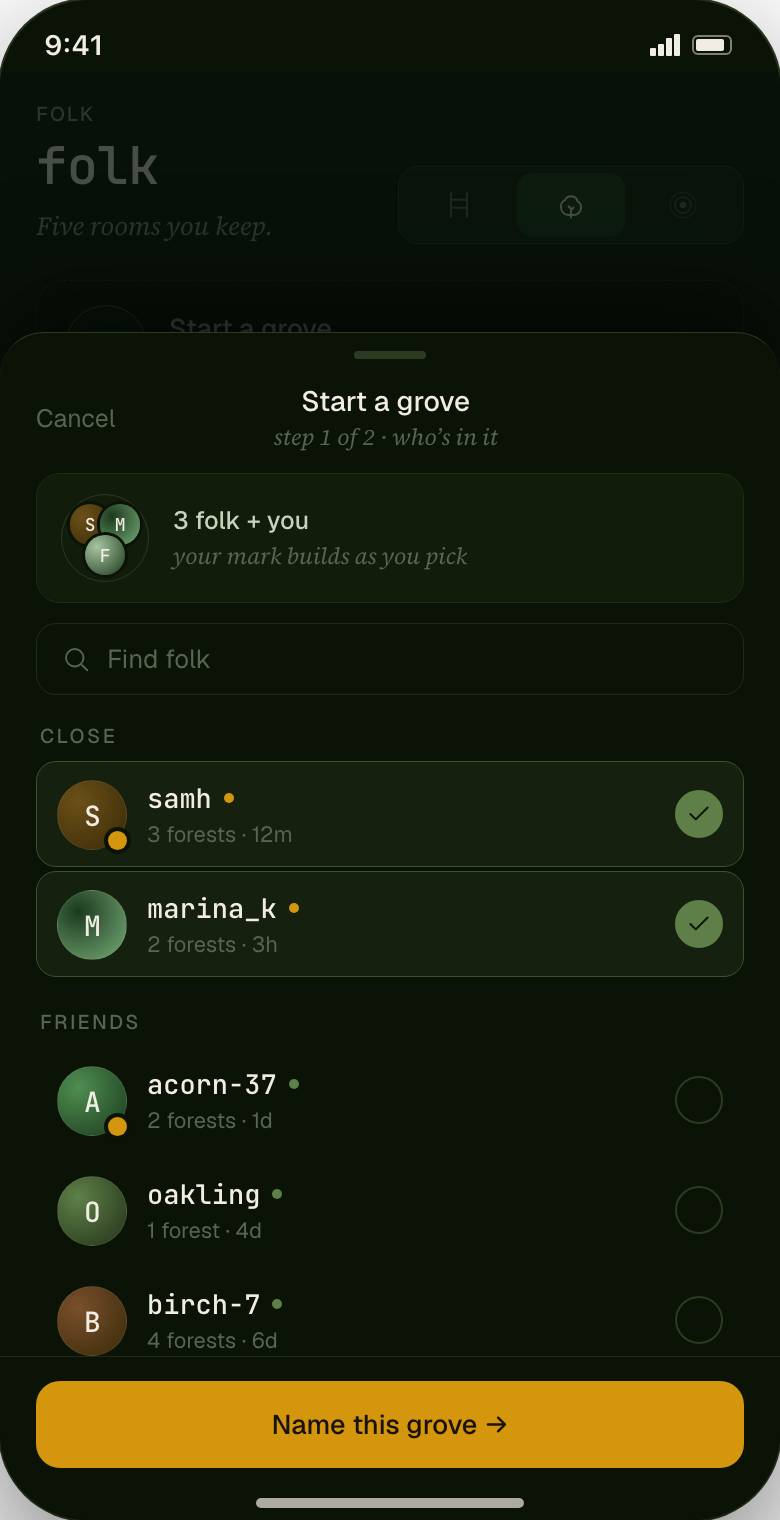
Strangers aren’t listed. If you want someone in a grove, invite them into a forest first — rooms are for people you already know.
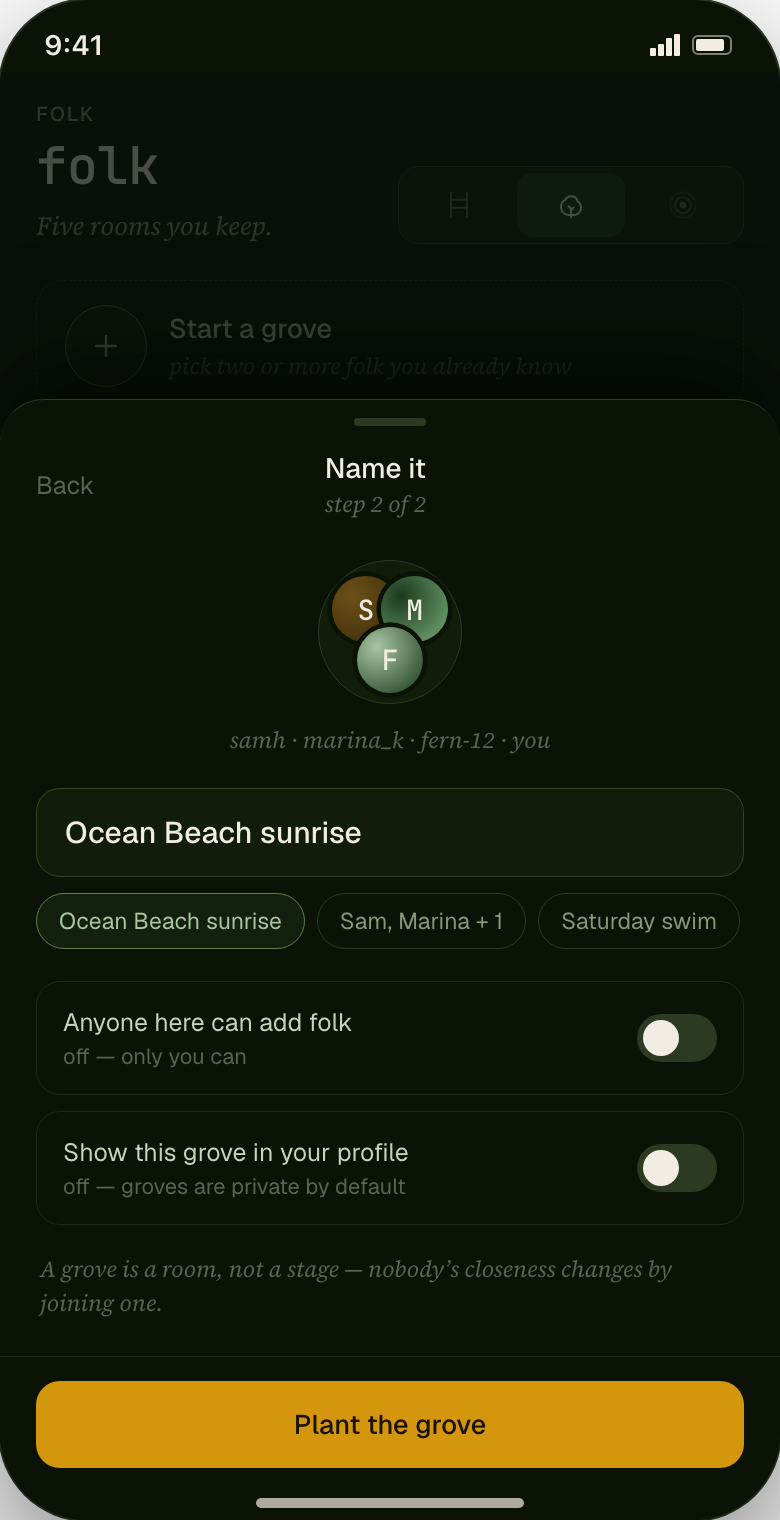
The suggestion chips mean the whole flow completes without typing a character. And the two toggles on the board shipped as zero toggles. Anyone here can add folk contradicted an older rule we weren’t willing to bend: adding someone to any room grows a new room alongside it, and the original stays exactly as it was — for everyone, no owner, nothing to administer. A permission switch would have invented a hierarchy the mechanic exists to avoid. Show this grove in your profile pointed at a profile surface that doesn’t exist yet, and a switch wired to nothing is a small lie with a nice animation. What survived is the sentence under them, which is the product guarantee in one line: a grove is a room, not a stage — nobody’s closeness changes by joining one.
Satellites, not people
The constellation gets the one thing only it can show: where your rooms sit against your closeness.
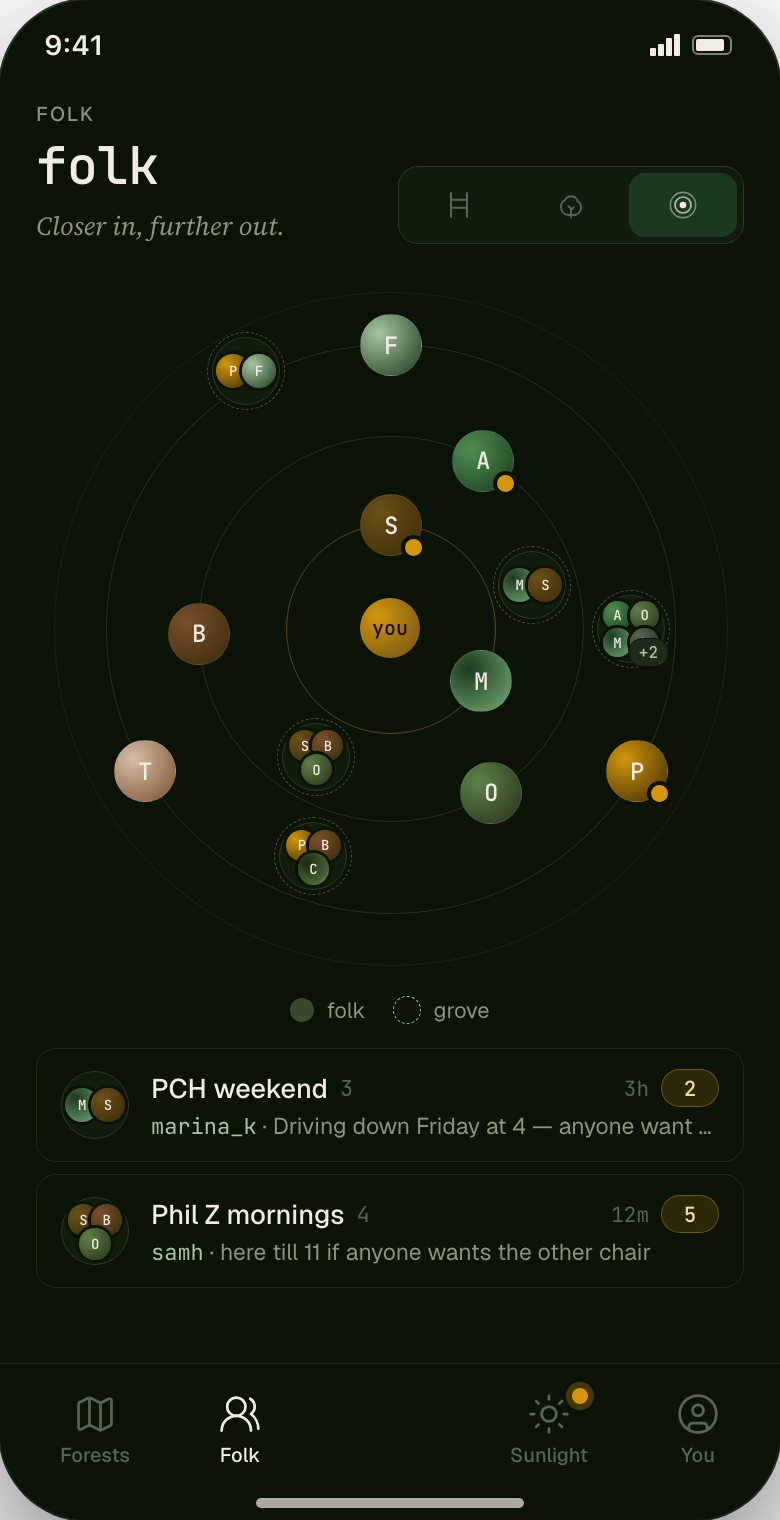
A grove floats between the rings, at the band of its closest member — the room hangs where your closest person in it lives. Every satellite wears a dashed collar, and the collar is the entire person/place distinction: filled disk, person; dashed circle, room. It never appears on a human and never goes missing on a grove.
Below the canvas, rooms repeat as quiet rows, so the view works one-handed. The board drew two of them; an afternoon of actually living in the build turned that into ten, and let one-to-one conversations mix in beside the groves — sorted by recency, the same tap into the same room. The design was right about the affordance and wrong about the appetite.
Rooms, planted.